
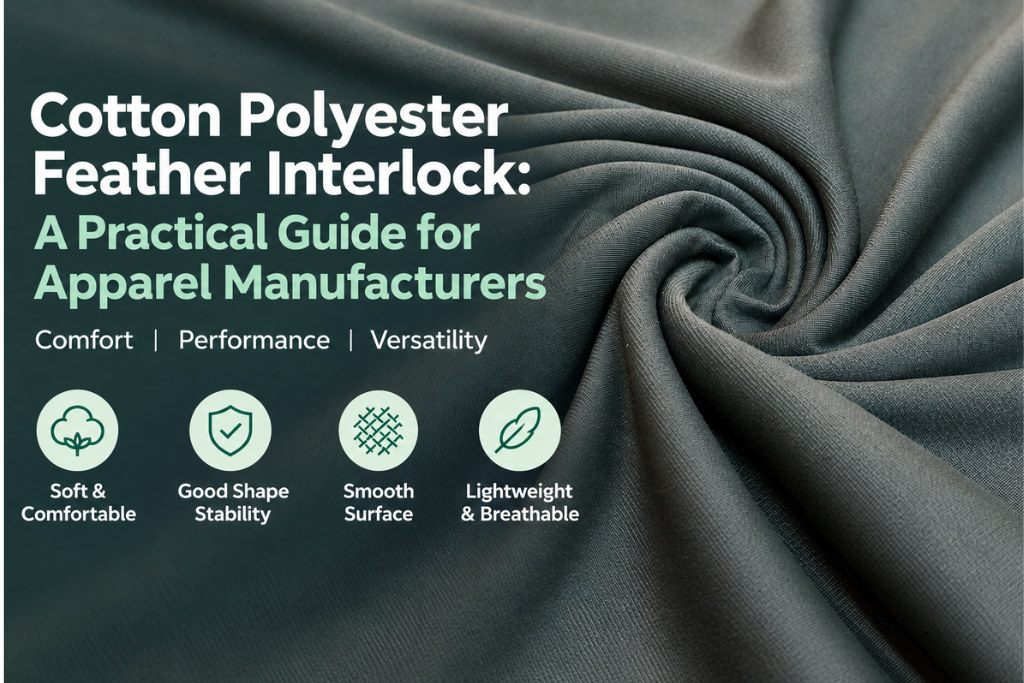
Cotton Polyester Feather Interlock: A Practical Guide for Apparel Manufacturers
Knitted Fabric Manufacturers in India are crucial in providing fabrics that offer both comfort and wearability, along with aesthetics and manufacturing considerations. There are many types of knitted constructions available currently, and cotton-polyester feather interlock is an ideal choice for apparel makers who want to use fabrics that offer comfort and good performance.
The combination of cotton and polyester in interlock construction makes this fabric a versatile fabric for the production of different apparel. Knowledge about its structure, properties, uses, and considerations can be quite useful for apparel makers.
What Is Cotton Polyester Feather Interlock?
Cotton Polyester Feather Interlock is a knit fabric that results from the blending of cotton and polyester fibers in an interlock fabric construction.
Interlock fabrics have a smooth texture, good stability, and are relatively denser compared to other types of knit fabrics.
While polyester helps in giving the fabric strength and improved resilience, cotton gives the fabric softness and comfort. Performance characteristics of this fabric will be determined by many factors such as fiber composition, yarn type, GSM, finishing, and production specification.
“Feather” in this case refers to any type of interlock fabric that is lighter and hence provides comfort to wearers without being too heavy.
Key Characteristics of Cotton Polyester Feather Interlock
Apparel producers need to know about the fabric’s basic properties before choosing this material for production.
Comfortable Feeling of the Fabric
Cotton provides a comfortable and soft feeling of the fabric because of its natural properties. This property can be useful when producing casual clothes.
Good Shape Stability
The presence of polyester in the fabric helps it to keep its shape. It can be useful for producing clothes that have to maintain their shape through many wearings and washes.
Smooth Knitted Surface
Interlock structure makes both surfaces of the fabric smooth. This makes clothes made from such fabrics look attractive and makes this fabric appropriate for different finishing and garment production.
Well Balanced Properties
A mixture of cotton and polyester fibers gives manufacturers the possibility to get a fabric that has both comfortable properties and good performance.
Where Is Feather Interlock Used?
The cotton-polyester feather interlock can be used in a variety of clothing segments. The choice would depend on the GSM requirement, fiber composition, stretch content, finishing, and garment design.
Some common uses include:
- T-Shirts & Tops
- Kids’ Clothing
- Loungewear
- Lightweight Sweatshirts
- Sport & Active Wear
- Comfort Wear
- Casual Fashion Wear
- Uniforms
The manufacturers can make choices depending on the end-use requirements. A lighter fabric construction may suit comfort wear better than a heavier construction.
What Should Apparel Manufacturers Check Before Buying?
Selecting the right fabric is not just picking up a certain cotton-polyester blend. The manufacturer needs to consider a variety of parameters before issuing an order.
1. Fiber Content:
It is always a good idea to know the exact fiber content for cotton and polyester.
2. GSM:
The GSM is one of the major considerations while choosing the right fabric, as it affects the appearance and other features like cover of the garment.
3. Dimensional Stability:
Shrinkage and dimensional stability of dimensions are critical for the fabric that will be used under conditions of frequent washing or garment manufacture.
4. Colorfastness:
Colorfastness is essential for the proper appearance of the garment after its washing, rubbing, and wearing.
5. Surface Finish:
It is always good if the surface finish is chosen according to the requirements of the garment.
6. Consistency from Lot to Lot:
For producing large volumes of apparel, consistency of GSM, shade, width, composition, and quality of the fabric is critical.
Why Fabric Selection Matters in Apparel Production
The material plays a role in far more than just the appearance of the finished garment. The material can influence how easily it cuts, the stitching properties, the fit of the garment, its washability, its comfort, and the overall quality of the finished item.
In certain circumstances, cotton polyester feather interlock could be a good material because the material combines the comfort of cotton along with some of the benefits that come with polyester. In any case, the exact material specification will need to be determined based on the intended usage of the garment.
There are other factors besides the type of material to consider when choosing which fabric to use. These include roll width, roll length, dyability, finishing, MOQ, lead times, and customization.
Choose PI Cottex for Your Knitted Fabric Requirements
At PI Cottex, we realize that manufacturers need fabrics that have certain features related to quality, performance, appearance, and production consistency. We provide solutions in terms of knitted fabric for various applications and help our clients find the suitable specifications for their needs.
We take into consideration reliable fabric quality together with the suitable composition, GSM, finish, and other production factors. For manufacturers who want to find the most reliable solution among knitted fabric manufacturers in India, PI Cottex can help in selecting the suitable fabric depending on the application.
For manufacturers considering cotton polyester feather interlock and other knitted fabrics, finding the suitable specification and a reliable fabric supplier is a crucial factor in producing the garment.
0 comments